Why technology extinction is rare
June 19th, 02008 by Alexander Rose
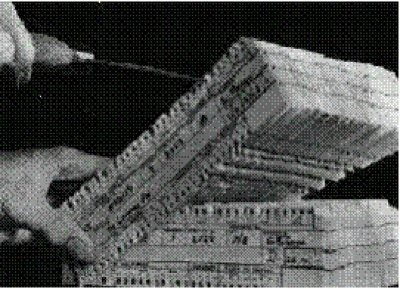
Kevin Kelly has a wonderfully detailed post about an organizational ‘hypercard’ system (with emphasis on the ‘card’) that as near as he can tell has gone extinct. Most interestingly Kelly posits that techno-extinction is actually a very rare thing:
Usually someone, somewhere will continue to employ the most ancient technology. There are probably more people making swords by hand now than in the past. On any given weekend in the US there will be a gathering of weekend flint knappers churning out mounds of magnificent arrow heads, using the exact technology of the stone age. Online you can buy new valves for a Stanley steam powered car, or leather parts for a horse drawn buggy, just as you could 100 years ago. In some parts of Africa and Asia any ancient tool is still manufactured in ancient ways. It is hard to find an old technology that is not available in any form any where on earth.
While I think that whole, evolved technologies going extinct is likely quite rare, my bet is that the record of the steps that got us to many of those technologies is rarer still. In fact if you take Kelly’s note above, that there are likely more people knapping arrowheads now than 40,000 year ago, he is likely right (on shear numbers, not per capita of course). But what about all the bad or inefficient techniques along the way to high quality knappery? Those are lost and unpracticed, just like the Indecks card system shown above, and many other dead computer media replaced by newer better versions. If we look at systems for organizing data now we can see a gradual lock in occurring toward relational databases (ackkk Oracle!). Once this paradigmatic lock in is complete, my bet is that many people will be using it well past its time of pure usefullness.
This loss of process is likely very widespread throughout all technologies, it often results in the final evolved technology surviving, but we often forget how we got there. Evidence of this is in the anecdotes of how a modern designer or engineer tries to improve an ancient system, only to find out that the ancient system is vastly superior (W. McDonough often cites the black Bedouin tent as an example, and S. Lansing has a similar story from Balinese water and agricultural systems). Until a technology is mature and standardized, which our digital tech is only beginning to be, we will continue to lose a lot of information stored on these obsolescing systems like Indecks.

June 20th, 2008 at 3:46 pm
Every set of technological, environmental and economic circumstances seems to create a corresponding set of engineering “sweet spots”, such as the internal combustion-powered automobile (one that may be shifting as fuel prices increase and technologies for energy storage improve), the steam locomotive, blue jeans, or the layout of an analog clock’s face. The technologies that fall outside these sweet spots tend to be blips (Pointcast, most Ronco products) or, if they were once widespread but the sweet spot’s shifted, tend to decline in use (like the fountain pen, all-wood bows and arrows, the atlatl or, as you mentioned, flintknapping). That’s not to say that they’re not still great technologies that have some unique advantages–for example, the glide of a well-tuned fountain pen is a beautiful thing, and you can make your own stickbow in less than a day–but the context that once made them widespread either changed or never really existed to begin with. It reminds me very much of evolution and the rise and fall of species populations. Perhaps some of the modeling effort that’s gone into that area of study would be applicable to the rise and fall of technologies as well.
In any case, the context for the technologies surrounding digital information storage is shifting quickly. Part of that’s a feedback loop: as our storage capabilities increase, they trigger a social change with respect to the things we want to store, which in turn drives changes in the characteristics of our storage systems. There was a time when WordStar documents needed to be small enough to fit comfortably on a 5.25″ floppy. Nowadays, you can buy a cheap terabyte of hard drive storage for a desktop machine and sling video files around with abandon, but WordStar’s document format wasn’t really up to embedded pictures and diagrams, much less embedded audio and video, so now we have new file formats like HTML, MS Word, and ODF that can do it but would somewhat tax the capabilities of a 128KB, 4.77MHz computer.
And part of it is a process of deciding what’s important and what isn’t. For instance, PDF exists to reproduce the layout of a document, essentially modeling the control that a typesetter or scribe has over text on paper, stone, or another solid medium. Whether or not it sticks around is likely to depend on how much importance we ultimately attach to that layout information. The importance of layout, and who should control it, is something we as a society are still coming to grips with in the context of static documents and have barely begun to address with audio and video. And the rate at which we come to grips with it depends on the rate at which society can assimilate and react to these new capabilities, which appears to be somewhat slower than the rate at which we can produce them.
July 3rd, 2008 at 1:08 pm
One of our developers mentioned the other day that I can still read punch tape code. It’s a bit like press proof readers who developed the skill for reading entire pages of text mirrored in lead type.
P