Last Year’s Model

August 28th, 02009 by Austin Brown

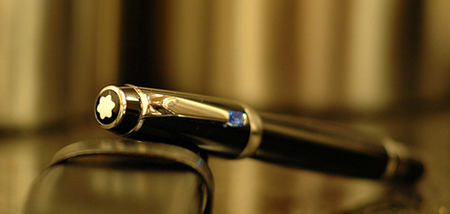
montblanc1.jpg

In his Seminar for the Long Now Foundation in January, Saul Griffith mentioned what he called the Rolex/Montblanc Pen approach to solving climate change.  As a way of cutting down on wasteful consumption (and the carbon embodied in consumer goods production), he suggests making and using fewer products.  The few products we do use, he explains, should be of the highest quality so that they’ll last and be worth using for our entire lives.  He exemplifies the idea by suggesting that everyone should be issued one Rolex watch and one Montblanc pen at birth:

I just have to own less stuff and make it last ten times as long.  Sometimes I call this the Rolex and Montblanc pen approach to life. So that just made me sound like a pretentious wanker. I am really not.  I am a deep green environmentalist and so what you want is when your child is born or when you are born to be issued a Rolex and a Montblanc pen and that’s the only writing implement, the only time piece you get for your whole life.

All right, so we solved just now writing and time reading but how about cell phones? So I think this is actually kind of great challenge.  The first company that makes the cell phone that will last a lifetime totally wins. That will be the most amazing thing.  For everyone in the audience who just got laid off please go and start a company to make a cell phone that lasts 100 years.  That would be the best thing you can do.

Anil Dash tells us that we’re already using plenty of very high-quality products.  Since there is no reason to throw out something that still works, he has started Last Year’s Model:

It’s totally normal to lust after the hottest new geeky gadgets. It’s also cool to put some thought into what we buy, and what we throw away. So this is a place to show the world that a lot of us are choosing to use Last Year’s Model.
lym_badge.jpg

In a way, it’s a prescriptive take on Kevin Kelly’s idea that species of technology never go extinct.  We may consider them ‘obsolete’ because we use a different tool for the job now, but somewhere someone is doing it the old fashioned way.  It can be a pretty fun challenge to find uses for the old tech you’ve got laying around and Dash’s site encourages people to submit the ways they’re still using iPods with (*gasp*) moving parts, or other less-than-shiny products from back in the day.

Also, I hope we can all agree that un-boxing videos have always been a little weird.

This entry was posted on Friday, August 28th, 02009 at 12:54 pm and is filed under Long Term Thinking, Seminars, Technology.

  • http://michaelnielsen.org/blog Michael Nielsen

    It’d be fun to collect a very large number of examples like the Rolex / Montblanc. I immediately thought of the Fisher space pen, the swiss army knife, and mag lights. All three are virtually indestructible.

  • vanderleun

    I’m so stuck with last year’s model that I’ve got last decade’s models. I’ve still got and use the original iPod, that old clunker that should be worth cash soon. I still can’t decide whether or not to get the case engraved.

  • vanderleun

    Oh, yes. I had the original G4 until last year when I finally upgraded to the G4 Mirror Door.

  • http://www.hongkonggong.com Jason

    Totally dig the idea — though the uniform “issuing” of luxury goods I don’t agree with. But the slow accumulation of luxury goods that are or become meaningful through time = priceless. Of course, the trick is to buy things that don’t become too unfashionable in a year, or even ten year’s, time.

  • John L

    People still wear watches?

  • William Crane

    If this way of thinking was applied towards all the purchases we make in our lives, including the major ones such as homes and vehicles, it could drastically reduce the amount of waste created in our society. However, a few young people posting comments about upgrading iPhones and the like a little less frequently trivializes the issue and gives the poster a feeling of “I’ve done my part!” when they have really done nothing.

  • Maggie Darwin

    I vote for the “pretentious wanker” theory.

  • Steve Midgley

    I just buy cheap stuff and hang on to it. You’d be surprised how long a pair of cheap sunglasses last. And cheap or expensive, I’m going to lose them on the subway eventually. I see people with stainless steel water bottles, and wonder what’s wrong with re-using a plastic bottle bought from the store. They’re cheaper to manufacturer and last a long time. You’re probably going to lose the cap to that stainless bottle before the energy investment in making it is going to payback on my cheap re-used plastic water bottle.

  • John Trinkl

    While this is a commendable recommendation, it’s also another example of an individualistic, atomized response to what is a far larger economic and political problem than us just changing our consumption habits. While making positive changes in our own lives, we also need to work hard to change the political and economic structures that give rise to these problems in the first place.

  • John Edds

    While I admire the goal of this line of thinking, making everything last as long as possible, right now, would be a very bad idea. Take the cellphone for example.

    What if a cellphone could be created that would last for a century? You’d have a long-lasting, very inefficient piece of technology. Think about what cellphones looked like in 1989*. Now imagine using that phone for a century. You’re lugging around half-a-kilo in battery and power-wasting circuits. That half-a-kilo phone in your bag weighs your car down more as you drive (wasted fuel), makes you heavier as you walk around (which equals more food that you ultimately have to eat–energy wasted for its production) and so forth.

    Cars are the same. Once upon a time they were built like tanks, and they had the fuel-economy to match.

    Refrigerators, light bulbs, computers–basically anything that uses electricity and/or combustion to work shouldn’t be made to last long-term until they’re as efficient in their opperation as the physical laws of the universe allow.

    Things which should be built to last–now–are things like buildings**, furniture, watches (more efficient than using a cellphone as a timepiece), pens, shovels, ladders, knives, dishes, wrenches–that sort of thing.

    *–What’re cellphones going to look like in another twenty years? Forty? A hundred? At a hundred we might not even have cellphones–perhaps we’ll communicate wirelessly with a mote-sized thing embedded in our brains and have a fractal antenna under the skin across our whole body. They’re powered by ATP, like the cells of our bodies. Who knows?

    **–If they’re well designed to save resources and energy–if not, don’t bother. The skyscraper equivalent of an earthship. Something like a monolithic dome made of “Ductal” concrete would last centuries, maybe thousands of years.

  • ulv

    Let’s think a bit further. Most people take the things that support our life for granted.

    Some years ago i lived in a seminar center where each participant of a seminar was
    given a piece of wood, a knife and a piece of sandpaper to make a spoon, to raise
    awareness of what you really need to survive.

    If you’ve ever tried to make a complete set of things that you use in everyday life you
    will get a feeling about what it takes to make it. And you will better take care of it.

    And knowing how to start a fire, make a bowl and spoon, maybe a bow and arrows, collect
    fibers to make rope or clothing, a qill and ink …. this will connect us with the history of mankind
    and our technology. Children should learn this at school.

    Instead of giving everyone a piece of the best technology – let’s give everyone a chance to find
    out what it takes to make it!

  • http://thesuburbanhomestead.wordpress.com/2009/09/04/compost-bin-september-4-2009/ Compost Bin- September 4, 2009 « The Suburban Homestead

    [...] Last Year’s Model. Yesterday the new Levenger catalog arrived in the mail. I am a total sucker for their products, and my Circe journal has become so vital to my working style that it is my signature accessory at meetings. I have a Levenger pen that I have used faithfully and exclusively for several years now. And yet the catalog always tempts me with newer and prettier versions of the models that are still serving me well, such as this season’s purple leather Circe cover. My black one is still going strong…but it’s not purple! This post on the Long Now blog reminded me that the value of buying a lifetime product is in using it for a lifetime, not just until a shinier newer version comes along. [...]

  • http://www.losangelesartists.net/ David

    This is a great idea in general, but even if my stuff didn’t wear out, I’d have to replace it (especially pens!) when I lose it.

  • Jparenti

    I still use an Apple MessagePad 2000, circa 1997. Handwriting recognition that still cannot be matched!

  • http://petinsurancetoday.com/ PI

    I just buy cheap stuff and hang on to it. You’d be surprised how long a pair of cheap sunglasses last. And cheap or expensive, I’m going to lose them on the subway eventually. I see people with stainless steel water bottles, and wonder what’s wrong with re-using a plastic bottle bought from the store. They’re cheaper to manufacturer and last a long time. You’re probably going to lose the cap to that stainless bottle before the energy investment in making it is going to payback on my cheap re-used plastic water bottle.

  • http://debtconsolidationexposed.com/ DC

    Totally dig the idea — though the uniform “issuing” of luxury goods I don’t agree with. But the slow accumulation of luxury goods that are or become meaningful through time = priceless. Of course, the trick is to buy things that don’t become too unfashionable in a year, or even ten year’s, time.

  • iCanicus

    Like most of the commentators, I agree with the concept of hanging on to items for a long period of time. Though it doesn’t necessarily promote commerce and help the economy (short term), it does allow manufacturers to focus on high-quality rather than something that can be discarded in a short time. I am guilty of always wanting to buy “the next best thing” but I’m learning to stick with what I have…as long as I purchase something that’s substantial enough to last for a very LONG time. A commentator made a comment on how he still uses his old Apple MessagePad from last decade. I love that! Bravo! I hope to hang on to my 3rd generation iPhone for that long but unlikely since the battery cell seems to be poor quality (HINT to you Apple!); however, the TouchPad is supposed to come out soon. Right? :-) Nonetheless, thought provoking blog entry. Again: Bravo!

  • http://erelevant.net Morgan

    On my desk is an Underwood No. 3 from 1917 that is still in use. In my pocket, a watch from 1878 that works as well as it did when it left the factory. I am typing this on an IBM Model M keyboard from 1986. I drive a 1979 Mercedes 300D with more than 280,000 miles.

    I love these things because they all were built with unmatched quality, yet somehow each one in our culture is valued monetarily lower than the “latest model” and is considered obsolete.

  • http://www.erelevant.net/2010/02/16/living-without-future-the-decay-of-value-and-meaning-in-the-media-age/ erelevant: electronic marketing, culture, and life on the digital frontier

    Living Without Future: The Decay of Value and Meaning in the Media Age…

    While our technology and products have become increasingly advanced, any sense of quality and value has started to come apart in the relentless product cycle. This cycle–an insistence on new and better–has infected our media and minds as we…

  • Jesse

    Does anyone know of a list of “Heirloom Products”? Has anyone compiled a list of products like Zippo lighters that are still being made 50+ years later with replacement parts still available. Products like the Morgan 4/4 a car with a 70+ year production run, still being made to this day. I'm looking for a “Cool Tools” (http://www.kk.org/cooltools/ ) site to find sustainable “Long Now” products. Anyone?

Some Rights Reserved (CC)

The Long Now Foundation
Fostering Long-term Responsibility
est. 01996.