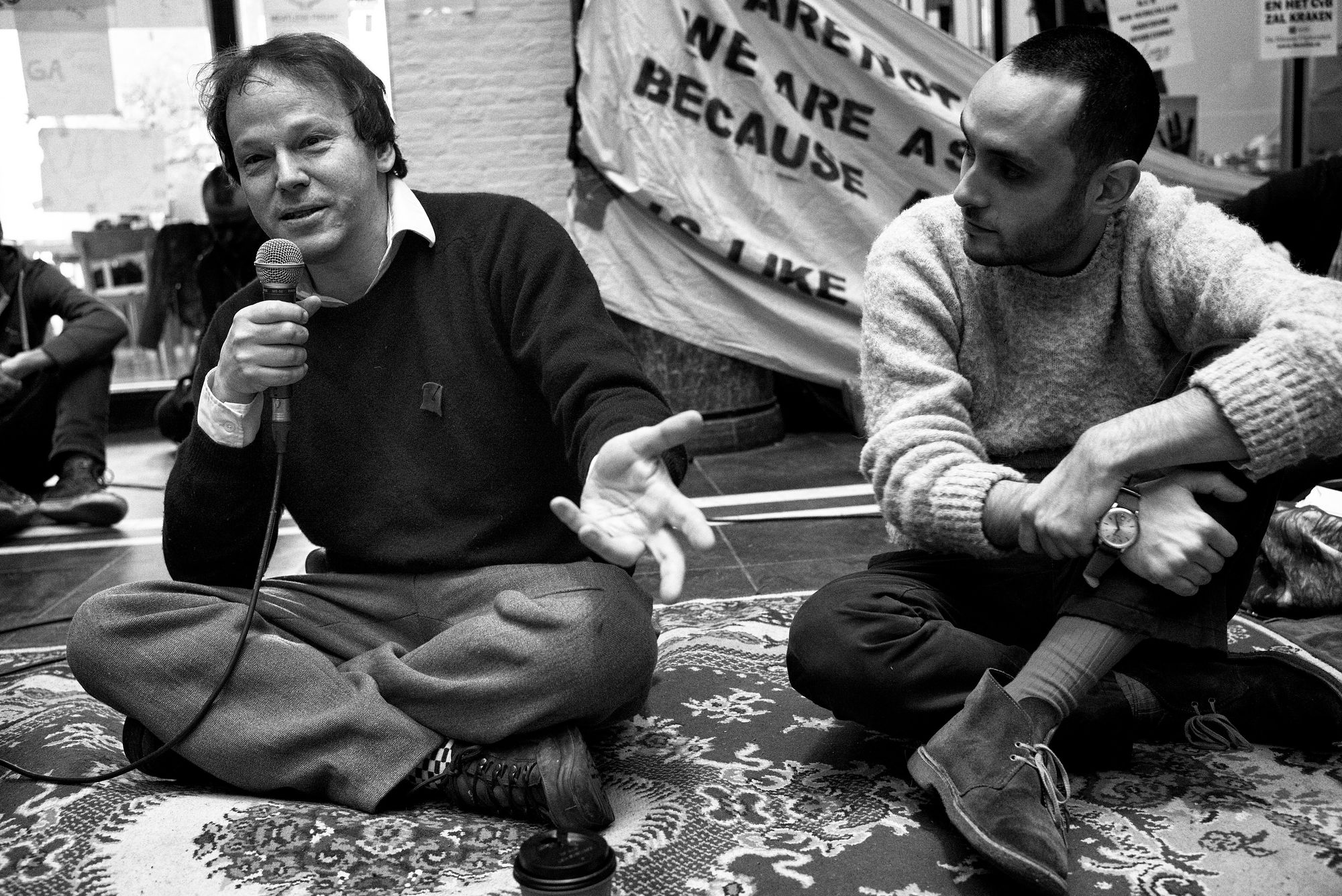
Debt: The first five thousand years

April 22nd, 02010 by Alexander Rose - Twitter: @zander

Anthropologist David Graeber recently sent in his essay on the 5000 year history of debt (orignally published in Mute and Eurozine).  Aside from being an interesting read in general, this effort (which he is just now finishing as a book) is an interesting resource for the Eternal Coin and the Long Finance project.

Debt: The first five thousand years by David Graeber

Throughout its 5000 year history, debt has always involved institutions – whether Mesopotamian sacred kingship, Mosaic jubilees, Sharia or Canon Law – that place controls on debt’s potentially catastrophic social consequences. It is only in the current era, writes anthropologist David Graeber, that we have begun to see the creation of the first effective planetary administrative system largely in order to protect the interests of creditors.

What follows is a fragment of a much larger project of research on debt and debt money in human history. The first and overwhelming conclusion of this project is that in studying economic history, we tend to systematically ignore the role of violence, the absolutely central role of war and slavery in creating and shaping the basic institutions of what we now call “the economy”. What’s more, origins matter. The violence may be invisible, but it remains inscribed in the very logic of our economic common sense, in the apparently self-evident nature of institutions that simply would never and could never exist outside of the monopoly of violence – but also, the systematic threat of violence – maintained by the contemporary state.

Let me start with the institution of slavery, whose role, I think, is key. In most times and places, slavery is seen as a consequence of war. Sometimes most slaves actually are war captives, sometimes they are not, but almost invariably, war is seen as the foundation and justification of the institution. If you surrender in war, what you surrender is your life; your conqueror has the right to kill you, and often will. If he chooses not to, you literally owe your life to him; a debt conceived as absolute, infinite, irredeemable. He can in principle extract anything he wants, and all debts – obligations – you may owe to others (your friends, family, former political allegiances), or that others owe you, are seen as being absolutely negated. Your debt to your owner is all that now exists.

This sort of logic has at least two very interesting consequences, though they might be said to pull in rather contrary directions. First of all, as we all know, it is another typical – perhaps defining – feature of slavery that slaves can be bought or sold. In this case, absolute debt becomes (in another context, that of the market) no longer absolute. In fact, it can be precisely quantified. There is good reason to believe that it was just this operation that made it possible to create something like our contemporary form of money to begin with, since what anthropologists used to refer to as “primitive money”, the kind that one finds in stateless societies (Solomon Island feather money, Iroquois wampum), was mostly used to arrange marriages, resolve blood feuds, and fiddle with other sorts of relations between people, rather than to buy and sell commodities. For instance, if slavery is debt, then debt can lead to slavery. A Babylonian peasant might have paid a handy sum in silver to his wife’s parents to officialise the marriage, but he in no sense owned her. He certainly couldn’t buy or sell the mother of his children. But all that would change if he took out a loan. Were he to default, his creditors could first remove his sheep and furniture, then his house, fields and orchards, and finally take his wife, children, and even himself as debt peons until the matter was settled (which, as his resources vanished, of course became increasingly difficult to do). Debt was the hinge that made it possible to imagine money in anything like the modern sense, and therefore, also, to produce what we like to call the market: an arena where anything can be bought and sold, because all objects are (like slaves) disembedded from their former social relations and exist only in relation to money.

But at the same time the logic of debt as conquest can, as I mentioned, pull another way. Kings, throughout history, tend to be profoundly ambivalent towards allowing the logic of debt to get completely out of hand. This is not because they are hostile to markets. On the contrary, they normally encourage them, for the simple reason that governments find it inconvenient to levy everything they need (silks, chariot wheels, flamingo tongues, lapis lazuli) directly from their subject population; it’s much easier to encourage markets and then buy them. Early markets often followed armies or royal entourages, or formed near palaces or at the fringes of military posts. This actually helps explain the rather puzzling behaviour on the part of royal courts: after all, since kings usually controlled the gold and silver mines, what exactly was the point of stamping bits of the stuff with your face on it, dumping it on the civilian population, and then demanding they give it back to you again as taxes? It only makes sense if levying taxes was really a way to force everyone to acquire coins, so as to facilitate the rise of markets, since markets were convenient to have around. However, for our present purposes, the critical question is: how were these taxes justified? Why did subjects owe them, what debt were they discharging when they were paid? Here we return again to right of conquest. (Actually, in the ancient world, free citizens – whether in Mesopotamia, Greece, or Rome – often did not have to pay direct taxes for this very reason, but obviously I’m simplifying here.) If kings claimed to hold the power of life and death over their subjects by right of conquest, then their subjects’ debts were, also, ultimately infinite; and also, at least in that context, their relations to one another, what they owed to one another, was unimportant. All that really existed was their relation to the king. This in turn explains why kings and emperors invariably tried to regulate the powers that masters had over slaves, and creditors over debtors. At the very least they would always insist, if they had the power, that those prisoners who had already had their lives spared could no longer be killed by their masters. In fact, only rulers could have arbitrary power over life and death. One’s ultimate debt was to the state; it was the only one that was truly unlimited, that could make absolute, cosmic, claims.

The reason I stress this is because this logic is still with us. When we speak of a “society” (French society, Jamaican society) we are really speaking of people organised by a single nation state. That is the tacit model, anyway. “Societies” are really states, the logic of states is that of conquest, the logic of conquest is ultimately identical to that of slavery. True, in the hands of state apologists, this becomes transformed into a notion of a more benevolent “social debt”. Here there is a little story told, a kind of myth. We are all born with an infinite debt to the society that raised, nurtured, fed and clothed us, to those long dead who invented our language and traditions, to all those who made it possible for us to exist. In ancient times we thought we owed this to the gods (it was repaid in sacrifice, or, sacrifice was really just the payment of interest – ultimately, it was repaid by death). Later the debt was adopted by the state, itself a divine institution, with taxes substituted for sacrifice, and military service for one’s debt of life. Money is simply the concrete form of this social debt, the way that it is managed. Keynesians like this sort of logic. So do various strains of socialist, social democrats, even crypto-fascists like Auguste Comte (the first, as far as I am aware, to actually coin the phrase “social debt”). But the logic also runs through much of our common sense: consider for instance, the phrase, “to pay one’s debt to society”, or, “I felt I owed something to my country”, or, “I wanted to give something back.” Always, in such cases, mutual rights and obligations, mutual commitments – the kind of relations that genuinely free people could make with one another – tend to be subsumed into a conception of “society” where we are all equal only as absolute debtors before the (now invisible) figure of the king, who stands in for your mother, and by extension, humanity.

What I am suggesting, then, is that while the claims of the impersonal market and the claims of “society” are often juxtaposed – and certainly have had a tendency to jockey back and forth in all sorts of practical ways – they are both ultimately founded on a very similar logic of violence. Neither is this a mere matter of historical origins that can be brushed away as inconsequential: neither states nor markets can exist without the constant threat of force.

One might ask, then, what is the alternative?

Towards a history of virtual money

Here I can return to my original point: that money did not originally appear in this cold, metal, impersonal form. It originally appears in the form of a measure, an abstraction, but also as a relation (of debt and obligation) between human beings. It is important to note that historically it is commodity money that has always been most directly linked to violence. As one historian put it, “bullion is the accessory of war, and not of peaceful trade.”[1]

The reason is simple. Commodity money, particularly in the form of gold and silver, is distinguished from credit money most of all by one spectacular feature: it can be stolen. Since an ingot of gold or silver is an object without a pedigree, throughout much of history bullion has served the same role as the contemporary drug dealer’s suitcase full of dollar bills, as an object without a history that will be accepted in exchange for other valuables just about anywhere, with no questions asked. As a result, one can see the last 5 000 years of human history as the history of a kind of alternation. Credit systems seem to arise, and to become dominant, in periods of relative social peace, across networks of trust, whether created by states or, in most periods, transnational institutions, whilst precious metals replace them in periods characterised by widespread plunder. Predatory lending systems certainly exist at every period, but they seem to have had the most damaging effects in periods when money was most easily convertible into cash.

So as a starting point to any attempt to discern the great rhythms that define the current historical moment, let me propose the following breakdown of Eurasian history according to the alternation between periods of virtual and metal money:

I. Age of the First Agrarian Empires (3500-800 BCE). Dominant money form: Virtual credit money

Our best information on the origins of money goes back to ancient Mesopotamia, but there seems no particular reason to believe matters were radically different in Pharaonic Egypt, Bronze Age China, or the Indus Valley. The Mesopotamian economy was dominated by large public institutions (Temples and Palaces) whose bureaucratic administrators effectively created money of account by establishing a fixed equivalent between silver and the staple crop, barley. Debts were calculated in silver, but silver was rarely used in transactions. Instead, payments were made in barley or in anything else that happened to be handy and acceptable. Major debts were recorded on cuneiform tablets kept as sureties by both parties to the transaction.

Certainly, markets did exist. Prices of certain commodities that were not produced within Temple or Palace holdings, and thus not subject to administered price schedules, would tend to fluctuate according to the vagaries of supply and demand. But most actual acts of everyday buying and selling, particularly those that were not carried out between absolute strangers, appear to have been made on credit. “Ale women”, or local innkeepers, served beer, for example, and often rented rooms; customers ran up a tab; normally, the full sum was dispatched at harvest time. Market vendors presumably acted as they do in small-scale markets in Africa, or Central Asia, today, building up lists of trustworthy clients to whom they could extend credit. The habit of money at interest also originates in Sumer – it remained unknown, for example, in Egypt. Interest rates, fixed at 20 percent, remained stable for 2,000 years. (This was not a sign of government control of the market: at this stage, institutions like this were what made markets possible.) This, however, led to some serious social problems. In years with bad harvests especially, peasants would start becoming hopelessly indebted to the rich, and would have to surrender their farms and, ultimately, family members, in debt bondage. Gradually, this condition seems to have come to a social crisis – not so much leading to popular uprisings, but to common people abandoning the cities and settled territory entirely and becoming semi-nomadic “bandits” and raiders. It soon became traditional for each new ruler to wipe the slate clean, cancel all debts, and declare a general amnesty or “freedom”, so that all bonded labourers could return to their families. (It is significant here that the first word for “freedom” known in any human language, the Sumerian amarga, literally means “return to mother”.) Biblical prophets instituted a similar custom, the Jubilee, whereby after seven years all debts were similarly cancelled. This is the direct ancestor of the New Testament notion of “redemption”. As economist Michael Hudson has pointed out, it seems one of the misfortunes of world history that the institution of lending money at interest disseminated out of Mesopotamia without, for the most part, being accompanied by its original checks and balances.

II. Axial Age (800 BCE – 600 CE). Dominant money form: Coinage and metal bullion

This was the age that saw the emergence of coinage, as well as the birth, in China, India and the Middle East, of all major world religions.[2] From the Warring States period in China, to fragmentation in India, and to the carnage and mass enslavement that accompanied the expansion (and later, dissolution) of the Roman Empire, it was a period of spectacular creativity throughout most of the world, but of almost equally spectacular violence. Coinage, which allowed for the actual use of gold and silver as a medium of exchange, also made possible the creation of markets in the now more familiar, impersonal sense of the term. Precious metals were also far more appropriate for an age of generalised warfare, for the obvious reason that they could be stolen. Coinage, certainly, was not invented to facilitate trade (the Phoenicians, consummate traders of the ancient world, were among the last to adopt it). It appears to have been first invented to pay soldiers, probably first of all by rulers of Lydia in Asia Minor to pay their Greek mercenaries. Carthage, another great trading nation, only started minting coins very late, and then explicitly to pay its foreign soldiers.

Throughout antiquity one can continue to speak of what Geoffrey Ingham has dubbed the “military-coinage complex”. He may have been better to call it a “military-coinage-slavery complex”, since the diffusion of new military technologies (Greek hoplites, Roman legions) was always closely tied to the capture and marketing of slaves. The other major source of slaves was debt: now that states no longer periodically wiped the slates clean, those not lucky enough to be citizens of the major military city-states – who were generally protected from predatory lenders – were fair game. The credit systems of the Near East did not crumble under commercial competition; they were destroyed by Alexander’s armies – armies that required half a ton of silver bullion per day in wages. The mines where the bullion was produced were generally worked by slaves. Military campaigns in turn ensured an endless flow of new slaves. Imperial tax systems, as noted, were largely designed to force their subjects to create markets, so that soldiers (and also, of course, government officials) would be able to use that bullion to buy anything they wanted. The kind of impersonal markets that once tended to spring up between societies, or at the fringes of military operations, now began to permeate society as a whole.

However tawdry their origins, the creation of new media of exchange – coinage appeared almost simultaneously in Greece, India, and China – appears to have had profound intellectual effects. Some have even gone so far as to argue that Greek philosophy was itself made possible by conceptual innovations introduced by coinage. The most remarkable pattern, though, is the emergence, in almost the exact times and places where one also sees the early spread of coinage, of what were to become modern world religions: prophetic Judaism, Christianity, Buddhism, Jainism, Confucianism, Taoism, and eventually, Islam. While the precise links are yet to be fully explored, in certain ways, these religions appear to have arisen in direct reaction to the logic of the market. To put the matter somewhat crudely: if one relegates a certain social space simply to the selfish acquisition of material things, it is almost inevitable that soon someone else will come to set aside another domain in which to preach that, from the perspective of ultimate values, material things are unimportant, and selfishness – or even the self – illusory.

III. The Middle Ages (600 CE – 1500 CE). The return to virtual credit money

If the Axial Age saw the emergence of complementary ideals of commodity markets and universal world religions, the Middle Ages[3] were the period in which those two institutions began to merge. Religions began to take over the market systems. Everything from international trade to the organisation of local fairs increasingly came to be carried out through social networks defined and regulated by religious authorities. This enabled, in turn, the return throughout Eurasia of various forms of virtual credit money.

In Europe, where all this took place under the aegis of Christendom, coinage was only sporadically, and unevenly, available. Prices after 800 AD were calculated largely in terms of an old Carolingian currency that no longer existed (it was actually referred to at the time as “imaginary money”), but ordinary day-to-day buying and selling was carried out mainly through other means. One common expedient, for example, was the use of tally-sticks, notched pieces of wood that were broken in two as records of debt, with half being kept by the creditor, half by the debtor. Such tally-sticks were still in common use in much of England well into the 16th century. Larger transactions were handled through bills of exchange, with the great commercial fairs serving as their clearing houses. The Church, meanwhile, provided a legal framework, enforcing strict controls on the lending of money at interest and prohibitions on debt bondage.

The real nerve centre of the Medieval world economy, though, was the Indian Ocean, which along with the Central Asia caravan routes connected the great civilisations of India, China, and the Middle East. Here, trade was conducted through the framework of Islam, which not only provided a legal structure highly conducive to mercantile activities (while absolutely forbidding the lending of money at interest), but allowed for peaceful relations between merchants over a remarkably large part of the globe, allowing the creation of a variety of sophisticated credit instruments. Actually, Western Europe was, as in so many things, a relative late-comer in this regard: most of the financial innovations that reached Italy and France in the 11th and 12th centuries had been in common use in Egypt or Iraq since the 8th or 9th centuries. The word “cheque”, for example, derives from the Arab sakk, and appeared in English only around 1220 AD.

The case of China is even more complicated: the Middle Ages there began with the rapid spread of Buddhism, which, while it was in no position to enact laws or regulate commerce, did quickly move against local usurers by its invention of the pawn shop – the first pawn shops being based in Buddhist temples as a way of offering poor farmers an alternative to the local usurer. Before long, though, the state reasserted itself, as the state always tends to do in China. But as it did so, it not only regulated interest rates and attempted to abolish debt peonage, it moved away from bullion entirely by inventing paper money. All this was accompanied by the development, again, of a variety of complex financial instruments.

All this is not to say that this period did not see its share of carnage and plunder (particularly during the great nomadic invasions) or that coinage was not, in many times and places, an important medium of exchange. Still, what really characterises the period appears to be a movement in the other direction. Most of the Medieval period saw money largely delinked from coercive institutions. Money changers, one might say, were invited back into the temples, where they could be monitored. The result was a flowering of institutions premised on a much higher degree of social trust.”

IV. Age of European Empires (1500-1971). The return of precious metals

With the advent of the great European empires – Iberian, then North Atlantic – the world saw both a reversion to mass enslavement, plunder, and wars of destruction, and the consequent rapid return of gold and silver bullion as the main form of currency. Historical investigation will probably end up demonstrating that the origins of these transformations were more complicated than we ordinarily assume. Some of this was beginning to happen even before the conquest of the New World. One of the main factors of the movement back to bullion, for example, was the emergence of popular movements during the early Ming dynasty, in the 15th and 16th centuries, that ultimately forced the government to abandon not only paper money but any attempt to impose its own currency. This led to the reversion of the vast Chinese market to an uncoined silver standard. Since taxes were also gradually commuted into silver, it soon became the more or less official Chinese policy to try to bring as much silver into the country as possible, so as to keep taxes low and prevent new outbreaks of social unrest. The sudden enormous demand for silver had effects across the globe. Most of the precious metals looted by the conquistadors and later extracted by the Spanish from the mines of Mexico and Potosi (at almost unimaginable cost in human lives) ended up in China. These global scale connections that eventually developed across the Atlantic, Pacific, and Indian Oceans have of course been documented in great detail. The crucial point is that the delinking of money from religious institutions, and its relinking with coercive ones (especially the state), was here accompanied by an ideological reversion to “metallism”.[4]

Credit, in this context, was on the whole an affair of states that were themselves run largely by deficit financing, a form of credit which was, in turn, invented to finance increasingly expensive wars. Internationally the British Empire was steadfast in maintaining the gold standard through the 19th and early 20th centuries, and great political battles were fought in the United States over whether the gold or silver standard should prevail.

This was also, obviously, the period of the rise of capitalism, the industrial revolution, representative democracy, and so on. What I am trying to do here is not to deny their importance, but to provide a framework for seeing such familiar events in a less familiar context. It makes it easier, for instance, to detect the ties between war, capitalism, and slavery. The institution of wage labour, for instance, has historically emerged from within that of slavery (the earliest wage contracts we know of, from Greece to the Malay city states, were actually slave rentals), and it has also tended, historically, to be intimately tied to various forms of debt peonage – as indeed it remains today. The fact that we have cast such institutions in a language of freedom does not mean that what we now think of as economic freedom does not ultimately rest on a logic that has for most of human history been considered the very essence of slavery.

Current Era (1971 onwards). The empire of debt

The current era might be said to have been initiated on 15 August 1971, when US President Richard Nixon officially suspended the convertibility of the dollar into gold and effectively created the current floating currency regimes. We have returned, at any rate, to an age of virtual money, in which consumer purchases in wealthy countries rarely involve even paper money, and national economies are driven largely by consumer debt. It’s in this context that we can talk about the “financialisation” of capital, whereby speculation in currencies and financial instruments becomes a domain unto itself, detached from any immediate relation with production or even commerce. This is of course the sector that has entered into crisis today.

What can we say for certain about this new era? So far, very, very little. Thirty or forty years is nothing in terms of the scale we have been dealing with. Clearly, this period has only just begun. Still, the foregoing analysis, however crude, does allow us to begin to make some informed suggestions.

Historically, as we have seen, ages of virtual, credit money have also involved creating some sort of overarching institutions – Mesopotamian sacred kingship, Mosaic jubilees, Sharia or Canon Law – that place some sort of controls on the potentially catastrophic social consequences of debt. Almost invariably, they involve institutions (usually not strictly coincident to the state, usually larger) to protect debtors. So far the movement this time has been the other way around: starting with the ’80s we have begun to see the creation of the first effective planetary administrative system, operating through the IMF, World Bank, corporations and other financial institutions, largely in order to protect the interests of creditors. However, this apparatus was very quickly thrown into crisis, first by the very rapid development of global social movements (the alter-globalisation movement), which effectively destroyed the moral authority of institutions like the IMF and left many of them very close to bankrupt, and now by the current banking crisis and global economic collapse. While the new age of virtual money has only just begun and the long-term consequences are as yet entirely unclear, we can already say one or two things. The first is that a movement towards virtual money is not in itself, necessarily, an insidious effect of capitalism. In fact, it might well mean exactly the opposite. For much of human history, systems of virtual money were designed and regulated to ensure that nothing like capitalism could ever emerge to begin with – at least not as it appears in its present form, with most of the world’s population placed in a condition that would in many other periods of history be considered tantamount to slavery. The second point is to underline the absolutely crucial role of violence in defining the very terms by which we imagine both “society” and “markets” – in fact, many of our most elementary ideas of freedom. A world less entirely pervaded by violence would rapidly begin to develop other institutions. Finally, thinking about debt outside the twin intellectual straitjackets of state and market opens up exciting possibilities. For instance, we can ask: in a society in which that foundation of violence had finally been yanked away, what exactly would free men and women owe each other? What sort of promises and commitments should they make to each other?

Let us hope that everyone will someday be in a position to start asking such questions. At times like this, you never know.

  • [1] Geoffrey W. Gardiner, “The Primacy of Trade Debts in the Development of Money”, in Randall Wray (ed.), Credit and State Theories of Money: The Contributions of A. Mitchell Innes, Cheltenham: Elgar, 2004, p.134.
  • [2] The phrase the “Axial Age” was originally coined by Karl Jaspers to describe the relatively brief period between 800 BCE – 200 BCE in which, he believed, just about all the main philosophical traditions we are familiar with today arose simultaneously in China, India, and the Eastern Mediterranean. Here, I am using it in Lewis Mumford’s more expansive use of the term as the period that saw the birth of all existing world religions, stretching roughly from the time of Zoroaster to that of Mohammed.
  • [3] I am here relegating most of what is generally referred to as the “Dark Ages” in Europe into the earlier period, characterised by predatory militarism and the consequent importance of bullion: the Viking raids, and the famous extraction of danegeld from England in the 800s, might be seen as one the last manifestations of an age where predatory militarism went hand and hand with hoards of gold and silver bullion.
  • [4] The myth of barter and commodity theories of money was of course developed in this period.

This entry was posted on Thursday, April 22nd, 02010 at 11:58 am and is filed under Long Term Science, Long Term Thinking.

  • http://taoist.wordpress.com Taoist

    Your perspective on debt and currency is an interesting one, and there’s certainly a facet of truth that money allows debt to be quantified, bartered, and exchanged. However, while you examine history through that lens, you disregard a basic economic fact which also greatly colors money:

    Trade is a win-win situation that benefits both parties (or why would they both participate in it?). Both parties in a trade come out better than they were before. Disregarding this fact leads you to entirely fail to think about, or even mention credit, the flip side of debt – also allowed by currency.

    Since both parties come out ahead in a trade, currency, of all types, also allows for wealth to be built up by parties, as credit which can be used in further trades without dropping any party into debt.

    While you’re trying to examine the connections between capitalism, slavery, and war, it would be entirely one-sided, biased, and naive not to also examine the ties through credit of capitalism to wealth, prosperity, and peace.

  • Ariel

    You didn’t consider something called a http://en.wikipedia.org/wiki/Pruzbul which essentially canceled out the effect of the 7 year jubilee.

    The idea of canceling debts every 7 years did not do a very good job acting as “checks and balances” because lenders would refuse to lend money when it got close to the jubilee.

  • http://qtp.blogspot.com Sachin

    very insightful…I never knew this much…..thanks

  • Arslan Farooq

    A very interesting read… thank you for sharing this…

  • http://growhappiness.com Eugen Groh

    Very interesting and inspiring article, thank you!

    The connection between the rise of religion and money as well as the great variety and diversity of financial systems that succeeded our current one were things I was not really aware of.

    Personally I think the deepest problem of our current capitalist financial system (apart from the systemic dependence on debt and the resulting obsession about economical growth as the only benchmark of socieatal wellbeing) is the blatantly obvious unfairness of earnings.

    Many people seem to defend current our capitalism by suggesting that it has proven to be the best financial system for producing wealth.

    For those people I’d like to point out that there is a big difference between getting money and actually earning it. We should emphasize the latter and gradually make the first option utterly impossible. (Apart from justified social benefits obviously).

    When you ask pretty much everyone agrees that people should be earning their money instead of just getting it – intuitively this simply makes moral sense.

    Yet capitalism is the exact opposite of this fair concept because it allows those with capital or property to sit back and let others work for it while the owners themselves can contribute nothing apart from usage rights and still demand astronomic interests. At it’s core the fairness of capitalism is only fair in the same sense in which survival of the fittest is fair. Capitalism is played by the rules of the jungle, often completely outside of otherwise acceptible social norms.

    Unfortunately I have no concrete idea how the fair alternative could look like in practice but there must in principle exist such a fair financial system.

    And I suspect we will soon have to find and adopt it, especially with the pending robotics revolution that will rapidly replace production workers and people in the service sector.

    Who will pay the living expenses of those unemployed masses and supply their material needs? Largely the owners of capital and property (especially the means of production). But it is rather obvious that at that point of robotic automation our current financial system is simply rendered obsolete.

    Unless there is a way to reeducate the soon-to-be unemployed masses into some form of intellectual occpuation that generates value. We’ll see.

  • http://www.mynext.co.uk steve

    Fascinating reading, thank you

  • http://toylit.blogspot.com Khakjaan Wessington

    Interesting, but too much of a ‘Classical/Eurocentric’ model. You completely ignore labor ‘levies’ which were a form of partial bondage in China. Labor levies are at least as old as specie itself. Commerce grew western cities in their earliest stages, but political/military complexes grew Chinese cities. It’s why there were all those mid 20th century anthropologists who claimed that China didn’t have ‘real’ cities until the late Ming or early Qing.

    That said, I find your account interesting, but really, beware of the Eurocentric bias.

  • http://slowlorisfamily.blogspot.com mr slow loris

    @Taoist:

    Trade does leave both parties a little wealthier than before, however there are more parties involved with trade than the traders. The producers, shippers, and manufacturers of goods, the people doing the work and not the owners, do not see the benefit of trade in the same way that the elite negotiating trade do. Trade above the scale of producer-consumer involves some sort of violence in order to be profitable. Profit is theft; someone is getting screwed.

    @Eugen Groh:

    The majority of the “masses” is hungry for education and incapable of accessing it. Robot labor would remove not only the financial system but the whole concept of scarcity. We haven’t seen for a long time what man is capable of without struggle and I hope that we’ll be pleasantly surprised about how unique every member of the human species could be if we had something a little younger and more energetic to keep us company.

  • david graeber

    Thanks for the comments.

    I am of course aware of the prozbul but you know, that was introduced under King Herod, by the Rabbi Hillel – no one quite knows the origins of the Jubilee but it would seem to have been instituted at least 500 years before that, and quite possibly much earlier. It seems to me that if we introduced a financial reform now that only had to be qualified in 2510 people would not say it was thus proven unworkable!

    As for the association of capitalism with peace – yes everything’s associated with everything if you want to associate it. The point I was making was about historical ebbs and flows: giant empires, standing armies, slavery, etc, were typical of the Axial Age, largely vanished or were greatly attenuated during the Middle Ages (when the only really big empires were created by nomads, interestingly), and then all made a simultaneous come-back with the rise of capitalism and appear to be still with us.

    As for trade being a win-win situation: well, this strikes me as a circular argument, because it’s only true if you assume that if it’s not win-win, it’s not really trade. Often trade arises in direct relation to war: for instance, selling off the spoils from a looted city is advantageous to the soldiers who did the pillaging and the person who is able to provide them with food, drink, and prostitutes, but probably not so much for the people in the city, assuming they are not now dead or enslaved, or for that matter, the prostitutes, who are likely themselves to have been enslaved in some similar misfortune. This is a serious comment: most numismatists now believe that the reason gold and silver started being coined was because it was the most common form of loot, something soldiers were likely to be carrying around, divided up by the victims. There have been many times and places where peaceful trade took place that was obviously advantageous to all parties – the Medieval Indian Ocean, which was self-consciously demilitarized, is a good case in point. But in other traditions trade and war were barely distinguished: especially in Christian Europe, where whether Venetian galleys, for instance, were merchants, pirates, or crusaders depended entirely on the balance of forces of the moment. This is the reason that, as Servet has exhaustively shown, the words for “truck and barter” in almost all European languages were words that had only a century or two before meant “trick, swindle, or rip off.”

  • david graeber

    oh and to Khakjaan Wessington I appreciate the input but am a little confused. I’m not aware I offered any opinion about the origin of cities: and I do mention Chinese labor levies indirectly when I suggest that it was popular resistance to such levies, which eventually caused the Ming to go to the “single-whip” silver tax system, that began the world’s shift back to bullion (and incidentally made possible the profitability of the Spanish colonies in Peru and Mexico, since all that silver found an unlimited market in China.)

    In fact the first phase I describe, I don’t even mention Europe, since not much was going on there. True, I don’t talk about Shang China either, but frankly, before the Spring & Autumn period, we just don’t really know what was going on there, it’s all guess-work because the later historical sources are totally anachronistic, for instance, often projecting coinage back to 2000 BC, and archeology doesn’t tell us much. Peng’s monetary history of China (1994:98-101) provides the best overview of existing literary sources.:

    However there are fascinating hints of debt crises similar to the Middle Eastern ones: the Guan Zi for instance says money was first invented by early emperors to redeem children who had been pawned or sold for debt during famines.

    I personally don’t buy the idea that Chinese cities aren’t “real” cities, or even that their origins are so fundamentally different than Middle Eastern or European ones – I think it’s kind of Eurocentric, even Orientalizing, in itself. It’s true that as many remark Chinese cities did not have the same sort of tradition of self-governing assemblies one finds in early Uruk, in the “Ksatriya republics” of the Ganges Valley, in Mediterranean city-states, etc. Myself, I suspect the reasons more go back to the existence of strong lineage structures in China so that the focus of self-governance wasn’t so much around the geographical unit but rather organized by ancestries. But that’s just a guess.

    However, my main points, about the interest of strong states in creating markets, of the relation of coinage to war, etc, very much applies to China and I was keeping the Chinese case much in mind when developing it. China is actually a fascinating case: the main effect of the prevalence of levies there in my terms is that the currency turned out different; where the Hellenistic states and Mauryans, etc, used highly paid soldiers and mercenaries, and promulgated gold and silver currency, the Chinese states used mass levies and paid their soldiers on the cheap, in bronze. (This was incidentally like early Rome that also used peasant levies as troops and also had only bronze coins at first.) In China, however, it stuck – well, at least until the Ming.

    China is also important for the story because of the extreme prevalence of peasant rebellion and unrest, which caused the government to adopt unusually populist policies that made it, as Roy Bin Wong I think put it, the ultimate “anti-capitalist market state” – promulgating markets, but carefully keeping state monopolies on key industries (e.g, salt and iron) and guarding against the emergence of private monopolies or concentrated economic power, an approach which proved markedly effective since China did have higher standards of living than almost anywhere else in the world for centuries.

  • http://www.squidskate.com/artbobo/?p=35 Debt: The first five thousand years by David Graeber « artbobo blog

    [...] effective planetary administrative system largely in order to protect the interests of creditors. http://blog.longnow.org/2010/04/22/debt-the-first-five-thousand-years/ Comments [...]

  • http://wso.williams.edu/blogs/alan/2010/04/29/links-for-2010-04-28/ Life of Alan » links for 2010-04-28

    [...] "Debt: The first five thousand years" [Long Now Blog] (tags: Fixed_Income) [...]

  • tomcpp

    I find it a bit of a shortcoming that you only provide a tiny little bit of the story : you only provide talks of systems that worked.

    It would be great if you provided the “I’ll design a new system” idiots above with a bit of perspective, giving an account of a few of the countless systems that catastrophically failed (I don’t mean just the Soviets, but the jihad based empires for example, or so many of the Chinese “conquerors”, the mongol invasions that collapsed, …).

    Also, where do you get the idea that the muslim empires did not have debt slavery ? The ottoman empire raided villages for black slaves so far away it needed a large naval base on zanzibar (just look on the map just how far that is). Is that called peaceful these day ? Obviously, only for a tiny fraction of rich in Turkey was it ever peaceful. The stories, by the few black slaves that survived, tells of the horrors that slaves faced in the ottoman empire that far surpass the worst the Romans (or anyone else really) ever did to slaves. One could also point out that despite the importation of several hundred million screaming “black gold” into northern africa, the middle east and turkey (and presumably parts of India), there are none of those slaves left. There are not a few left, there did not intermarry, there are NONE left)

    Surely “peaceful” in the arab indian ocean came at a cost of hundreds of millions of “inferior” (mostly black, and tiny amounts of European) lives. Where tiny amounts still includes such “tiny” things as the Armenian massacre. One can only imagine how many islamic massacres of blacks there have been.

    The only way in which sharia “outlaws debt slavery” is in the way that muslims don’t bother to give you money before taking your life in slavery. In addition to that, muslims are the very worst slave masters ever to have walked this earth. Muslims treated their conquered populations worse than the Nazi’s treated the Jews. The point where stories start telling about commanding slaves to force large objects into (female) slaves’ “holes” while executing their children in front of them just for fun was only ever crossed by muslims.

    A slave in the southern plantations in the Americas, by contrast, had a measure of freedom that probably surpassed what a “free” man had in medieval europe, just 100 years earlier. Sexual slavery was perhaps not entirely nonexistent, though tiny, and you’ll find nothing of the pointless tortures muslims inflicted on their slaves. You should provide a bit of perspective on what it meant to be a slave.

    Again, during the republic period, being a roman slave was not all that bad an occupation, to the point where people entered into it voluntary. The “wage slavery” of today is entered into voluntary by large masses of people (the only argument you could make is that there is a lack of an alternative), and there are few abuses in large parts of the world. Lots of “wage slaves”, like roman slaves, are happy, content and are not mistreated.

    There are lots of generalizations that seem to call for a bit of attention.

  • Matt

    “What can we say for certain about this new era? So far, very, very little. Thirty or forty years is nothing in terms of the scale we have been dealing with. Clearly, this period has only just begun.”

    I predict this sentence will look a little short-sighted within a decade when we are picking up the pieces of the collapse of fiat currencies that we see unfolding today (Greece and Italy, perhaps appropriately, being at the epicenter of the collapse). A return to a commodity based system of currency seems the least bad of the available outcomes at this point.

  • david graeber

    I always wonder why anyone thinks anything else they say is going to be taken seriously when they say things like “Muslims treated their conquered populations worse than the Nazi’s treated the Jews.” Um, yeah. He is suggesting the entire population of the Middle East, North Africa, Spain, North India, and the Balkans (for example) were rounded up, put in cattle cars, and gassed to death? Or no, that something worse than that happened to them. What might that be?

    As for Rome, there were absolutely no legal limits on what a master could do to a slave of any kind under the Republic – if you wanted to chop a slave’s limbs off one by one, that was your decision – the first limitation was under Tiberius when it was made illegal to have a slave publicly ripped apart by wild animals without permission of a judge. It took another hundred years to make killing your own slave illegal – I think that was under Hadrian – which is quite remarkable since there is virtually no other known state that allowed masters to kill slaves with impunity. In China, for instance, one emperor had his own son tried and put to death for the arbitrary killing of a slave, just to make the point that no one could be killed without due process.

    For the record, the conversion of most of the population of the Middle East, Egypt, etc, to Islam occurred a couple centuries after the Arab conquest and establishment of the caliphate, and it was accomplished primarily by legal scholars, not state representatives, since the legal system operated independently from the state. At the time the perennial social problem, and plague of Middle Eastern peasants was – and had been for thousands of years – the habit of wealthy merchants and administrators making interest-bearing loans and then forcing family members into debt peonage or even slavery. One reason Islamic law was so well received is that for the first time it made all of that illegal: interest-bearing loans, sale of children, debt peonage. In fact, no free Muslim could be enslaved for any reason and non-believers could only be enslaved through war (which made enslavement of Jews, Parsis, Christians, etc living under the Caliphate illegal too.) What basically seems to have happened was a class re-alignment, with the merchants basically agreeing to give up all those practices in exchange for effectively becoming the community leaders _against_ the administrators and military classes, who were so broadly despised that people wouldn’t even serve in the army if there was any possibility of war was against other believers and the Caliphate and its successor states were forced to rely on armies composed mainly of slaves. The Mamluks were only the most famous of these. Anyone who considers taking seriously the rant about how Muslim slavery was so much worse than any other might consider the fact that these empires were the only ones in world history that relied on the systematic use of slaves as soldiers: that is, provided slaves with all their most sophisticated weapons. I think that pretty much tells you all you need to know. Slavery is never pretty and Medieval Islam did maintain the institution when it had largely been abolished elsewhere, but when you have things like slave dynasties ruling Egypt, it’s clearly not the same institution.

    One weird side effect of the split between government and civil law, which covered economic affairs and operated largely independently of the government, was that the Caliphate saw the birth of most of the free market ideas only later picked up in Europe in the eighteenth century. Adam Smith, weirdly, got many of his best material from twelfth century Persia (the pin factory originally appeared in al-Ghazali and the line about how you never saw two dogs exchanging a bone appears to come from Tusi. Mohammed himself is said to have declared that price controls are blasphemous because in a free market situation, prices are set by God – the invisible hand again, which in Smith is the hand of divine providence.) Of course, it was adopted in a very different context – the big difference is the Islamic economic thinkers never assumed the whole thing is based on competition, but ultimately, saw the market as a form of mutual aid – as I put it in the book, ‘you can’t have cut-throat competition when there’s no one stopping you from actually cutting each other’s throats.’ Rather they had a credit economy largely based on reputation, in which competition was only one element, and most ethical thinkers of the time considered it entirely appropriate to charge rich people more and poor people less for the same products. One thing I emphasize in the book is what happened when this free market rhetoric was grafted onto a totally different (European) tradition which never made a clear distinction between trade and war to begin with.

  • http://newsinprogress.wordpress.com/2010/05/01/the-history-of-debt/ The History of Debt « News in Progress

    [...] The History of Debt Posted in Economics, Movement of Consciousness by newsinprogress on May 1, 2010 http://blog.longnow.org/2010/04/22/debt-the-first-five-thousand-years/ [...]

  • http://firesaw.wordpress.com/2010/05/01/the-history-of-debt-the-daily-dish-by-andrew-sullivan/ The History Of Debt – The Daily Dish | By Andrew Sullivan « Firesaw

    [...] 1, 2010 · Leave a Comment David Graeber thinks it all began with [...]

  • http://madmanmusing.com/43/debt-the-source-of-money/ Debt – the source of money? | madmanmusing.com

    [...] Graeber has posted a very interesting essay entitled Debt: The first five thousand years over at The Long Now Blog (cross-posted at Eurozine/Mute). It is a fascinating read if (as many of [...]

  • http://gfmorris.com/2010/05/02/sunday-reading-2-may-2010/ Sunday Reading: 2 May 2010 | GFMorris.com

    [...] Debt: The First Five Thousand Years [longnow.org]. A brief history of debt in its societal forms, which seems to oscillate between virtual and commodity money. I am no Ron Paul, back-to-the-gold-standard person, by any regard. The key point, though, is that periods of virtual money are coincidental to periods of overarching societal institutions. I would really love to read a lot, lot more on this subject. [...]

  • http://leisureguy.wordpress.com/2010/05/02/debt-the-first-five-thousand-years/ Debt: The first five thousand years « Later On

    [...] in Business, Daily life, Government at 8:33 am by LeisureGuy Very interesting (and lengthy) post written by anthropologist David Graeber at The Long Now [...]

  • http://tkcollier.wordpress.com/2010/05/02/a-brief-history-of-debt/ A Brief History of Debt « Terryorisms

    [...] via Debt: The first five thousand years – The Long Now Blog. [...]

  • http://sentinels-of-sovereignty.123living.org/ Elvenrunelord

    Interesting article on debt and credit.

    I personally think we should go to a no-money economy or an equalateral distribution method. Each person in the USA could receive $50,000 if all the profit made in 2009 were distributed equally.

    50k is enough to live on in my opinion.

  • http://www.iamniz.co.uk/wordpress/2010/05/bookmarks-for-april-29th-through-may-6th/ Bookmarks for April 29th through May 6th « Daniel Nisbet

    [...] Debt: The first five thousand years – The Long Now Blog – [...]

  • http://taoist.wordpress.com Taoist

    @mr slow loris: You admit in one sentence that trade leaves both parties a little wealthier than before, and then a few later resort to “Profit is theft”!!?

    And you try to claim that the my argument doesn’t work because there’s an entire supply line behind the two parties doing the trading…but that whole supply line is also made up of trades, so there are in fact many more than just two profiting, in the view you take.

  • http://www.dwylcorneilius.blogspot.com Corneilius

    I really enjoyed your article, it’s instructive, in that you join the dots between money, debt and violence..

    Hierarchical structures are inherently violent. Self organisation is the fundamental of nature.

    Anthropology shows quite clearly that the vast majority if indigenous societies were and remain, where they exist, egalitarian in nature. Neuroscience also supports the idea that egalitrianism is innate.

    As regards Modern Trade, internationally and historically, trade has always been associated with violence – colonies were the product of violence. Every Nation state reserves the ‘right’ to exercise violence via Police, Justice Systems, Military and Secret Services as do all organised criminality and most organised religions, all of which depend upon conditioning children to accept, ‘adapt’ or be traumatised for any dissent.

    Nature is fundamentally co-operative and ‘civilisation’ if it is to become sustainable must align with natural processes. The most fundamental fact of nature is that all creatures and plants improve the habitat for ALL life… by being themselves. I don’t subscribe to ‘survival’ struggles in nature : I see thrivival (a word I have ‘coined’) everywhere.

    So for me, the issue is can we as people work to transform our processes to match nature? And can we do that and accept that those cultures that live on and with the land have every natural expectation to do so for the far distant future?

  • InCinty

    Have any of you readers read any of the works of Dr Niall Ferguson such as “The Ascent of Money” or “The House of Rothschild vol I & II” or gone to you tube and checked out “Money as Debt”? Do not disregard them because of the animated format, they are as accurate as a graduate school course in banking.

    Your education has just begun and I would encourage you to have a solid understanding of how debts works.

  • http://geekgirl397.wordpress.com/2010/05/08/links-for-2010-05-08/ links for 2010-05-08 « The Adventures of Geekgirl

    [...] Debt: The first five thousand years – The Long Now Blog (tags: economics History Debt) [...]

  • david graeber

    I read the first page of Niall Ferguson’s book and was so offended that I almost couldn’t continue. It started with the description of an Amazonian people who were so happy to no longer be hunter gatherers and drawn into the world of money (they were receiving state handouts of some kind) – to prove Hobbes was right and that “primitive” life was “nasty, brutish and short” and money has made things better for everyone. In fact the entire history of Native American-settler relations, in North and South America, shows that even settler war captives who ended up spending any length of time in Native American societies found the life so much freer and more fulfilling that half of them refused to return even when rescued by their own families, while just about every Native American (at least from non-state society like the Amazonians or Iroquois, etc) – who was taken to be brought up in settler society (the world of money) escaped at the first opportunity. Anyway, choosing one Amazonian society who seems okay because they’re getting state largesse (if this is even true) is almost unimaginably dishonest considering how many were enslaved, slaughtered, expropriated, tortured, or completely annihilated by that very same system. There’s no way the author could not have been aware of this. I mean, I got through the rest, yes, but it made me distrust every word I read afterwards. You could say that my approach and his are about diametrical opposites.

  • A

    I would very much like to read this article, but I can’t! My eyes hurt too much reading text this small, and if I enlarge it it gets wider than the screen. Could you do something about that, please?

  • david graeber

    have you tried downloading it and then just increasing the size of the font? Or even just copying it and pasting it into a word file and doing so?

  • http://jimgrisanzio.com/2010/05/14/beware-of-debt/ Beware of Debt « Jim Grisanzio

    [...] a perfectly horrifying (and excellent) read about the forces binding history and economics — Debt: The first five thousand years by David Graeber Some clips (quotes in [...]

  • izik

    Thanks for all your work Dave. I’d love if you incorporated the economic impact (specifically in the arena of debt) of the closely knit history of private institutions printing money for public states.

  • Peter

    “Or even just copying it and pasting it into a word file and doing so?”

    Surely Dr Graeber is not writing such superb contributions to anarchism aided by Microsoft products?? I wonder if you could tell us where End User Agreements fit into this history! :P

    Just pre-ordered the book, looks like yet another winner if this taster is anything to go by. If you’ll forgive the militaristic metaphor, it’s always refreshing to see another arrow in the side of free-market evangelism and its stranglehold on economic history, and this is certainly not your first. All the best!

  • El Rei

    I’m interested in buying the book but having a hard time finding it…can someone post/send a link?

  • http://arsnihili.wordpress.com/2010/06/13/pt-historia-e-violencia/ [pt] História e Violência « Ars Nihili

    [...] by _andre Leave a Comment Em seu artigo sobre a História da Dívida, o antropólogo Graeber chega à conclusão de que não se pode menosprezar o papel da Violência [...]

  • http://arsnihili.wordpress.com/2010/06/13/en-history-and-violence/ [en] History and Violence « Ars Nihili

    [...] by _andre Leave a Comment On his article on the History of Debt, anthropologist Graeber comes to the conclusion that we cannot ignore the role of Violence in [...]

  • Peter

    >El Rei:
    I preordered my copy here: http://www.bookdepository.com/book/9781933633862/Debt.

    Bona sort.

  • Daniel Bartsch

    With the destruction of ecosystems, there is the destruction of family and friends that is replaced by complex violent marauder organizations, in order to extract from damaged ecosystems, and a default of personal relations to colleague, and comrade and stylized marriage. Those less personal relations require some kind of economic “keeping track” either with virtual/religious/fantasy, or in the form of metal/military. Both are inferior to an intact ecosystem. A new ecosystem could be a mix of artificial, and the previous natural, as long as all biochemical, personal relations, information, and energy loops balance in a stable healthy and personal way.

  • John

    Dr Graeber

    This is a most fascinating article.  I saw you on Democracy Now and found this with a search.  I will get your book when it comes out.

    One thing that interests me is how your work complements the historical view of Rudolf Steiner, especially in his view of social history.  Your dates line up quite well with what he points to as the beginning and end of the various epochs.  And then your descriptions of the epochs is quite in line with his.

  • Robert Searle

    Yes, this is all very interest….but what about a new, and revolutionary understanding of capital…….

    http://www.p2pfoundation.net/Transfinancial_Economics

    http://p2pfoundation.net/Introduction_to_Transfinancial_Economics

  • Themichael

    Whoops — very few real-world transactions conform to the kind of trade you imagine here, Taoist, which is barter. The ideological work done by orthodox economics is to lead us to imagine that we can abstract away from the pervasive use of money in actual trade and instead imagine the whole thing as a network of barter. And, as you suggest, why would people bother to exchange one thing for another if they did not mutually benefit? However, the point is that the use of money brings the transaction, directly or indirectly, into contact with the practices that are used to establish and maintain the monetary standard. And, depending on the historical era, such practices are more or less coercive. Under the more coercive monetary standards, you can't resort to your theorem that if people can be bothered to trade, there must be mutual benefit.

  • http://www.jonathanbrun.com/2011/07/the-race-to-the-buyout-how-we-might-be-in-a-bubble.html The race to the buyout – how we might be in a bubble | Jonathan Brun

    [...] foundation, which include Jeff Bezzos of Amazon.com, understand this. They wrote a great piece on the history of debt here and are building a clock that will last 10,000 years – that is what I’m talking [...]

  • cityeyrie

    Interesting article, hadn’t really thought about slavery’s relationship to debt as opposed to debt’s relationship to slavery.
    One small point of fact – it was my understanding that early bills of credit measured values in barley or cows, not in relation to silver or other metal. Interest arose as a consequence of the fruitful nature of the loan – and charged as a percentage of the harvest, not the original loan. Interest became a burden when people switched to setting values in non-reproducing metals, and charged interest as a percentage of the loan, not a percentage of the profit made from whatever activity that loan facilitated. The usury banned by most religions is precisely this first form of loan – where the debtor has all the risk, and the creditor little besides the bother of selling whatever was put up for collateral.

  • advin jhonsire

    It was my understanding that the bill early trading, the value of barley, cows or not, in connection with silver or other metals. The interest rate is increased due to the fruitful nature of the loan – and will be charged as a percentage of the harvest, not the original loan.

  • http://www.facebook.com/people/Steven-Hales/1055705660 Steven Hales

    Could it also be that ideas are akin to inventions each having many fathers (mothers). The most famous example being Darwin and Wallace and the origin of the species.  But even the lightbulb had 8 or more almost simultaneous inventors.  You might consider that Smith’s observation was inevitable even without the Persian example. 

Some Rights Reserved (CC)

The Long Now Foundation
Fostering Long-term Responsibility
est. 01996.